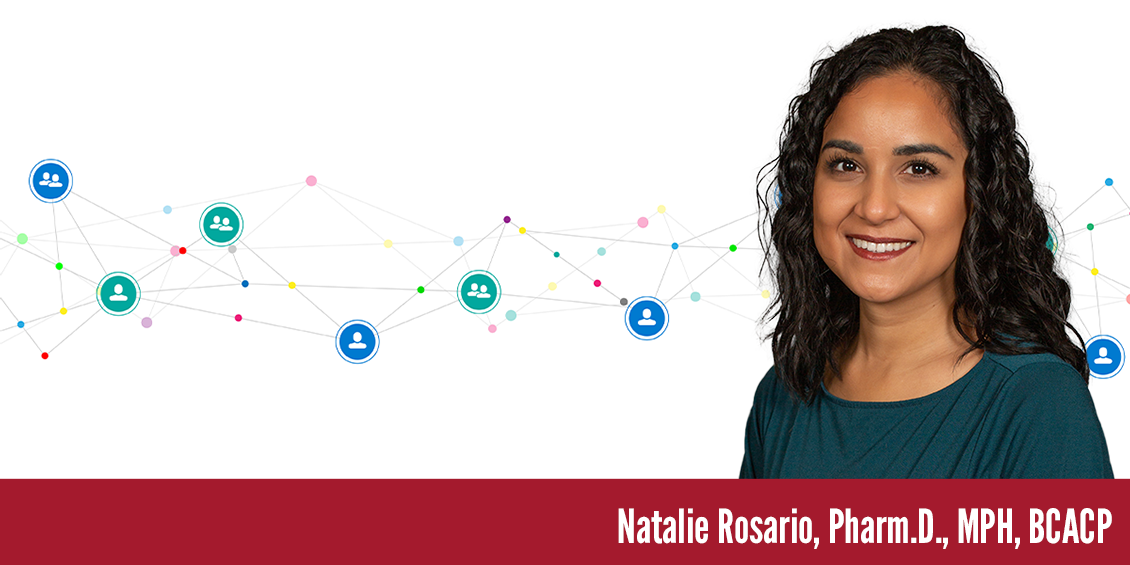
As a Puerto Rican native growing up in Kentucky, Natalie Rosario, Pharm.D., MPH, BCACP, often found herself as the only Hispanic or Latina in the room.
“I felt a lot of pressure to not just represent myself as ‘Natalie,' but also to represent the culture and Latino or Hispanic people in general,” Rosario said.
While doing her undergraduate, Rosario decided to take the pharmacy path, inspired by the evident passion for high-quality patient care demonstrated by her mother, a hospital pharmacist.
In pharmacy school, she was one of three Hispanic students in her class of 140 students. She pursued a career in pharmacy as someone from an underrepresented, minoritized identity among pharmacy students, faculty, and the general population of Kentucky.
Rosario said the pressure she put on herself drove her to become the best version of herself.
“If someone were to see me and think or expect that everybody from my particular background acted like this, I wanted to be a good representation,” Rosario said.
Rosario’s journey into working with underserved populations began during an internship at a federally qualified health center (FQHC) in Lexington, Ky. She witnesses the transformative impact of comprehensive care in patient’s lives and enjoyed the interprofessional patient medical home model, where patients had access to their primary care provider, ambulatory care pharmacists, social workers, behavioral health, and other services.
“I think this led me to where I am career-wise, working with underserved patients who are predominantly Spanish speakers,” Rosario said.
She earned dual degrees in Public Health and Pharmacy, having a clear aim in mind.
“I wanted to sharpen my skill set related to public health knowing my goal was to work in a FQHC,” Rosario said. “Getting an MPH helped me think more globally about initiatives to help underserved populations.”
Her experiences in Kentucky ignited her passion for advocating for all patients, regardless of socio-economic status, race, or language barriers.
“I feel very strongly that underserved patient populations deserve high-quality and comprehensive care to promote health equity and improve their health and well-being,” Rosario said.
Representation Matters
Rosario’s work emphasizes the importance of representation and awareness across all facets of health care.
“It is crucial for health care professionals to mirror their population,” she said. “This includes representation from underrepresented groups in all areas of pharmacy, including students, pharmacists, administrators and educators.”
Rosario has co-authored multiple articles about the lack of racial/ethnic awareness in academic and health care settings as well as its effects along with UHCOP Joshua Wollen, Pharm.D. One of these articles, published in the American Journal of Pharmaceutical Education (AJPE), explains how to train students to mitigate racial or ethnic microaggressions towards patients. Another publication in AJPE discusses how to mitigate microaggressions in pharmacy academia interviews. Her latest article is focused on minimizing stereotypes and biases in professional identity formation, which is the process of feeling as part of a professional community.
According to Rosario, microaggressions can come from anyone, from peers, colleagues, to patients and administrators. Although microaggressions may be unintentional, they are not as “micro” as the term suggests.
“There is an analogy of microaggressions being like a mosquito bite,” Rosario said. “One aggression may seem to be bothersome or annoying, but if someone gets continuously bitten it can add up to negatively impact someone’s well-being.”
Power Dynamics and Preceptorship
Pharmacy is a demanding space to navigate, with students, pharmacists and preceptors required to perform at peak levels over long periods. According to Rosario, in her commentary published in the journal Exploratory Research in Clinical and Social Pharmacy, many pharmacy students have had difficult encounters with preceptors that have made learning more challenging.
“This commentary helped bring some of those challenges to light and reinforce that preceptors should also be receptive to constructive feedback from learners,” Rosario said. “One example of how I incorporate rotation feedback is by having weekly check-ins and adjusting the timelines on flexible deliverables if the students are feeling overwhelmed. These modified timelines allow students to hone in on their clinical and presentation skills and deliver high-quality work.”
Rosario knows well what makes a good preceptor. In 2022, Rosario was awarded the UHCOP Preceptor of the Year Award. She was also awarded the UHCOP Ro Chi Teaching Excellence Award for 2022-2023.
“Preceptors should be lifelong learners not only in clinical knowledge but also in adapting their precepting style,” she said. “They must demonstrate their interpersonal and interprofessional skills in real time.”
Next and Current Projects
Outside of the DEI sphere, Rosario is working on multiple research projects.
Rosario recently presented at the 2024 American Pharmacists Association Annual Meeting in Orlando, Fla. Her presentation reviewed disparities in care that patients with diabetes may encounter, such as lack of transportation, disability, or cost of insurance. The presentation focused on ways to address these patient-specific barriers with the goal of enhancing the patient's diabetes treatment.
She also has ongoing projects related to patient care at her clinical practice site Vecino Health Denver Harbor Family Health Center, an FQHC serving a predominantly Hispanic/Spanish-speaking patient population on Houston’s near-northeast side. Alongside UHCOP Clinical Assistant Professors Jodie Gee, Pharm.D. ('09), BCACP, CDE, and Bernadette Asias-Dinh, Pharm.D. (’11), BCPS, CDE, Rosario sees Denver Harbor patients two half-days a week one-on-one for chronic disease state management.
In addition, she is collaborating with colleagues at the University of Texas Medical Branch in Galveston on GLP1-RA GIP effects on patient metabolic parameters.
Advice to Future Pharmacists
Her advice to students is to seek opportunities to learn about DEI, whether they are offered by the university, or other trainings and courses.
“Treat others with kindness and respect,” Rosario said. “Speak up when you witness injustices.”