From finding the first deep-water hydrocarbons in the Gulf of Mexico to locating the
meteorite impact that doomed the dinosaurs, scientific ocean drilling has unlocked
some major mysteries. A University of Houston (UH) geologist hopes to uncover more
such secrets as co-chief scientist on a major international expedition to recover
the first-ever drill core from the lower crust of the Pacific Ocean.
Jonathan E. Snow, an associate professor in the department of Earth and atmospheric
sciences, will co-lead 28 scientists, chosen from hundreds of applicants around the
world, aboard the JOIDES Resolution research vessel on a voyage supported by the Integrated
Ocean Drilling Program. The geoscientists on this two-month, $10 million expedition
will gather rock samples and data from the lower crust of the ocean that will distinguish
between two competing theories on the rate and location of the intrusion of magma
into the Earth’s lowermost crust.
“We will be the first to see the rocks that test these models, with the rest of the
global ocean crust community eagerly waiting to see the results,” Snow said. “Volcanoes
are spectacular things, but they do much more than pose hazards for human populations.
They are directly responsible for creating the ocean crust beneath two-thirds of our
planet. Deep beneath the volcanic eruptions, molten magma that doesn’t erupt cools
slowly to form the crystalline layers of the deep crust, through processes that we
don’t yet understand well.”
Covered by miles of water and rock, the deepest layers of the ocean crust are about
as inaccessible as it gets, and little was known about them until the 1970s, when
deep-diving submersibles and deep-water drilling vessels came on the scene. Since
then, scientific drilling has discovered that the ocean crust is formed by a continuous
process of volcanic seafloor spreading, one of the key revelations that led to the
acceptance of the theory of plate tectonics governing many of the key processes that
shape the Earth.
“The formation of the deepest layers, the intrusive lower crust, is the most difficult
part to study, because it’s situated not only beneath three to five miles of seawater
and sediment, but also beneath the extrusive upper layers,” Snow said. “Getting at
these deep layers requires a combination of deep drilling, using advanced technologies
developed for oilfield use, and a location where deep cracks in the Earth remove much
of the volcanic layer, making the lower crust more accessible.”
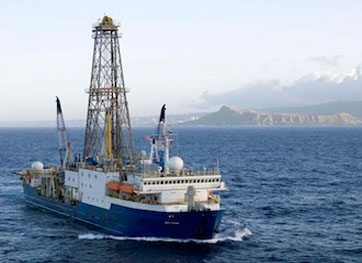
The JOIDES Resolution is the ship that will drill into the lower crust. Designed for
deep-sea exploration, it is more than 450 feet long, with a drilling derrick, accommodations
for 130 people and a floating laboratory for the analysis of core samples. Snow will
share his co-chief scientist duties with Kathryn Gillis, professor in the School of
Earth and Ocean Sciences and associate dean of the Faculty of Science, at the University
of Victoria in Canada. They will join 26 other international scientists on this expedition
from December to February.
“Researchers work their entire careers to be co-chief scientist on one of these expeditions,”
Snow said. “I am flattered that my name came to the top of the list. I’m only the
second person from UH ever to get the call.”
###
About the University of Houston
The University of Houston is a Carnegie-designated Tier One public research university
recognized by The Princeton Review as one of the nation’s best colleges for undergraduate
education. UH serves the globally competitive Houston and Gulf Coast Region by providing
world-class faculty, experiential learning and strategic industry partnerships. Located
in the nation’s fourth-largest city, UH serves more than 39,500 students in the most
ethnically and culturally diverse region in the country. For more information about
UH, visit the university’s newsroom at http://www.uh.edu/news-events/.
About the College of Natural Sciences and Mathematics
The UH College of Natural Sciences and Mathematics, with 187 ranked faculty and more
than 5,000 students, offers bachelor’s, master’s and doctoral degrees in the natural
sciences, computational sciences and mathematics. Faculty members in the departments
of biology and biochemistry, chemistry, computer science, earth and atmospheric sciences,
mathematics and physics conduct internationally recognized research in collaboration
with industry, Texas Medical Center institutions, NASA and others worldwide.
About the Integrated Ocean Drilling Program
The Integrated Ocean Drilling Program (IODP) is an international research program
dedicated to advancing scientific understanding of the Earth through drilling, coring
and monitoring the subseafloor. The JOIDES Resolution is a scientific research vessel
managed by the U.S. Implementing Organization of IODP (USIO). Together, Texas A&M
University, Lamont-Doherty Earth Observatory of Columbia University and the Consortium
for Ocean Leadership comprise the USIO. IODP is supported by two lead agencies: the
U.S. National Science Foundation (NSF) and Japan’s Ministry of Education, Culture,
Sports, Science, and Technology. Additional program support comes from the European
Consortium for Ocean Research Drilling (ECORD), the Australia-New Zealand IODP Consortium
(ANZIC), India’s Ministry of Earth Sciences, the People’s Republic of China (Ministry
of Science and Technology), and the Korea Institute of Geoscience and Mineral Resources.
For more information, visit http://www.iodp.org.
To receive UH science news via e-mail, sign up for UH-SciNews.
For additional news alerts about UH, follow us on Facebook and Twitter.