Today, we walk in some very old footsteps. The University of Houston's College of Engineering presents this series about the machines that make our civilization run, and the people whose ingenuity created them.
A million and a half years ago, a band of our Homo erectus forebears walked along the shallow shore of a river in Ileret, Kenya. It was after a seasonal flood and their footprints were preserved in the claylike mud. Twenty-thousand years later, another group left another layer of prints there. They too were covered over and preserved. Now archaeologists have found them.
These are the second oldest known hominid tracks. The other set dates all the way back to Lucy. The 3.6 million-year-old Laetoli prints in Tanzania show Lucy, or her Australopithecus kin, walking on two legs. Now we have two snapshots of our evolution into bipedal beings. (You might wonder how we know their dates so well. The answer: Western Africa was frequently sprinkled with volcanic ash. It contains minerals that decay radioactively at a highly predictable rate. So geologists can calculate the age of these old footprints within a fraction of a percent.)
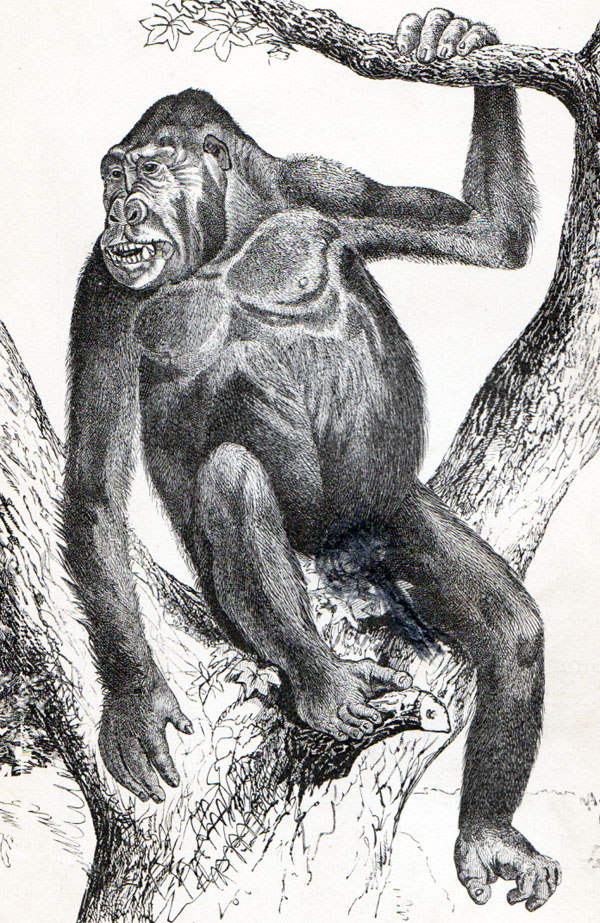
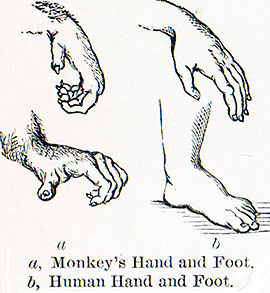
Lucy's Australopithecus feet aren't well defined, but it is clear that she'd made the transition from ape-walking to human-walking. An ape rolls forward, heel to toe on the outside of its foot, while its long thumb-like big toes splay in toward each other. A human continues that rolling motion across the front of its foot, to a much shorter, but load-bearing, big toe. By the way, the much older Lucy tracks may be less clear, but we can tell that a male and female walked side by side, close enough that they must be touching. I like to imagine them holding hands.
Unfortunately, the bones of Lucy's feet were never found. The Laetoli prints are all we have. So two questions linger: How many of the 26 bones of a modern human foot did she have? And exactly how did she walk upon those bones?
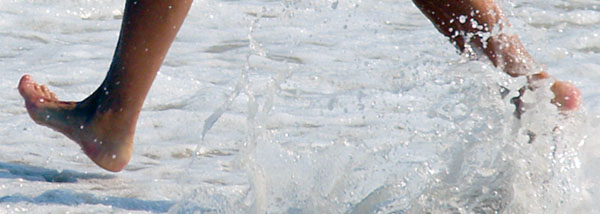
We don't have Homo erectus' foot bones either. But the Ileret footprints remain clear enough after a million and a half years to tell us that we walked then, much as we do now. The varying depth of the footprints reveals how weight was distributed. It's consistent with a full roll from heel, up the outside, and across the toes. Our African grandparent executed the same delicate ballet that we do as we stroll along sidewalks -- or along riverbanks.
More emerges from all this, of course. The natural selection of physical traits gave arboreal apes that long toe, so useless on the ground. They can grasp tree limbs while you and I, and Homo erectus, remain on the ground. But Homo erectus could chase down prey, while his hands were free to hurl a rock -- or a spear.
 Lucy and her companions lived almost two million years earlier still. And they could already walk, hand in hand, by the riverside -- even if they were still working on that wonderfully complex foot roll. Now the Ileret site tells us that Homo erectus, whose brain was maybe two-thirds the size of yours and mine, had developed feet that could run with the best of us.
I'm John Lienhard at the University of Houston, where we're interested in the way inventive minds work.
R. H. Crompton and T. C. Pataky, Stepping Out. Science, Vol. 323, 27 Feb. 2009, pp. 1174-1176. See also the full technical article attributed to 12 authors in the same issue: Early Hominin Foot Morphology Based on 1.5-Million-Year-Old Footprints from Ileret, Kenya. pp. 1197-1201.
For more on the Laetoli site, see: Laetoli: A Pliocene Site in Northern Tanzania. M. D. Leakey and J. M. Harris eds., (Oxford: Clarendon Press, 1987)
For a general account of early human evolution with more on footprints, see C. J. Cela-Conde and F. J. Ayala, Human Evolution: Trails from the Past. (Oxford: Oxford University Press, 2007).
See also the Wikipedia articles on the Laetoli site and the Ileret site.
Engravings from Steele's Popular Zoology, 1887. Photos by J. Lienhard.